
Sacred Music by Women Composers, Now Searchable by the Sunday It Serves
A Great Host of Composers had done the hard part. Three years, a grant from the Association of Anglican Musicians, and a team of nine had produced the best curated list of sacred choral and organ music by women composers I have seen. It lived in a Google Sheet with 17 tabs, and a search engine could not read a word of it.
 The church year
 Spreadsheet and PDF
It Lived in a Google Sheet Behind a TinyURL
A Great Host of Composers is a faith-based initiative founded by Susan Jane Matthews, Director of Music at St. Paul’s Episcopal Church in Burlingame, California. The mission is narrow: bring the music of women composers into sacred liturgies, by giving church musicians the repertoire and the recordings. The name comes from Psalm 68:11b, a great host of women bring the glad tidings, and the “b” is load-bearing, because the second half of the verse is the half about the women.
Most of the collection is keyed to the three-year Revised Common Lectionary, Sunday by Sunday and feast by feast. The rest is the music the lectionary does not govern: Evensong, Mass settings, the responses and Anglican chant, weddings, and the saints’ days that run on their own calendar. That mix is ordinary parish reality and it is the first thing a system built for this has to accommodate.
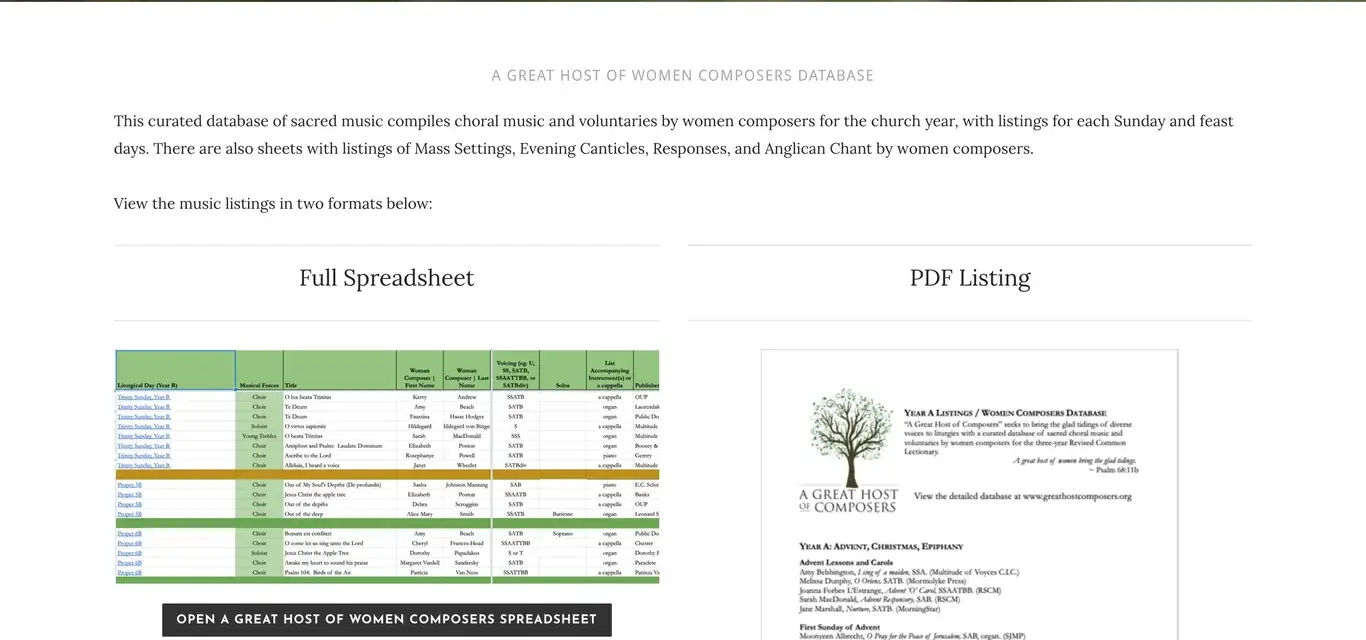
They published it the way you publish a dataset when nobody tells you not to. The website ran on Weebly, six pages of it, and the database page offered two ways in: a link to the Google Sheet, and four PDF outlines. The link to the sheet was a TinyURL. When I traced it, the TinyURL redirected through a VigLink affiliate interstitial before it reached Google Docs, so a director clicking the primary call to action on a grant-funded church music resource passed through an ad network on the way.
The sheet itself was 17 tabs, 22 columns, and roughly 1,270 rows. Search was Cmd+F.
A Google Sheet behind a shortener is one URL with no readable content, and a PDF outline is close to it. Every piece in that file was invisible to search. A music director in another diocese, typing “SATB Magnificat woman composer” into Google at 9pm while planning Advent, would never reach this work. Three years of research and a grant had produced a resource that only found the people who already knew it existed.
The obvious question is why it stayed that way. I assumed budget. Susan told me afterward that it was not.
“We diligently searched and interviewed prospective website designers, and they all lacked the expertise and understanding you hold in liturgy. I just gave up, as I felt it would be a disaster.”
That is a harder sentence to read than it looks, and I want to be careful not to flatter myself with it. She is not saying those designers were bad at their work. She is saying they could not tell which columns were load-bearing. Voicing, season, liturgical placement and lectionary year look like arbitrary metadata to anyone outside church music, and the failure mode is not an ugly website, it is a tidy one that has quietly normalised the distinctions the collection exists to preserve. She ran the search, took the meetings, and concluded that hiring the wrong person would cost her the dataset. She was right, so she kept the sheet and kept it current herself, by her own account for six years.
What I Am Actually Doing on a Tuesday in November
I play these services. On a Tuesday in November I am not browsing a catalogue of choral music. I am planning Advent 2 in Year B, and I need to know five things fast: what fits the appointed readings, what my choir can sing, whether it wants the organ or stands unaccompanied, whether I can hear it before I commit, and whether it is still in print and will reach me before the Sunday. That last one decides more programs than the first four, and it is the one a repertoire list usually cannot answer.
A spreadsheet cannot answer any of it in one pass. It can hold every fact you need and still make you do the joining in your head: filter the Year B tab, scan for Advent 2, read across 22 columns, hold the voicing in memory, check the forces column, open a link in a new tab to hear it. It takes me about five minutes a Sunday, and I know the sheet.
So the database is organized by the day, not by the title. For a festival the equivalent unit is a concert, for a school a student. The point is that your users arrive holding something, and the thing they arrive holding should be the front door.
The Church Year Became the Navigation
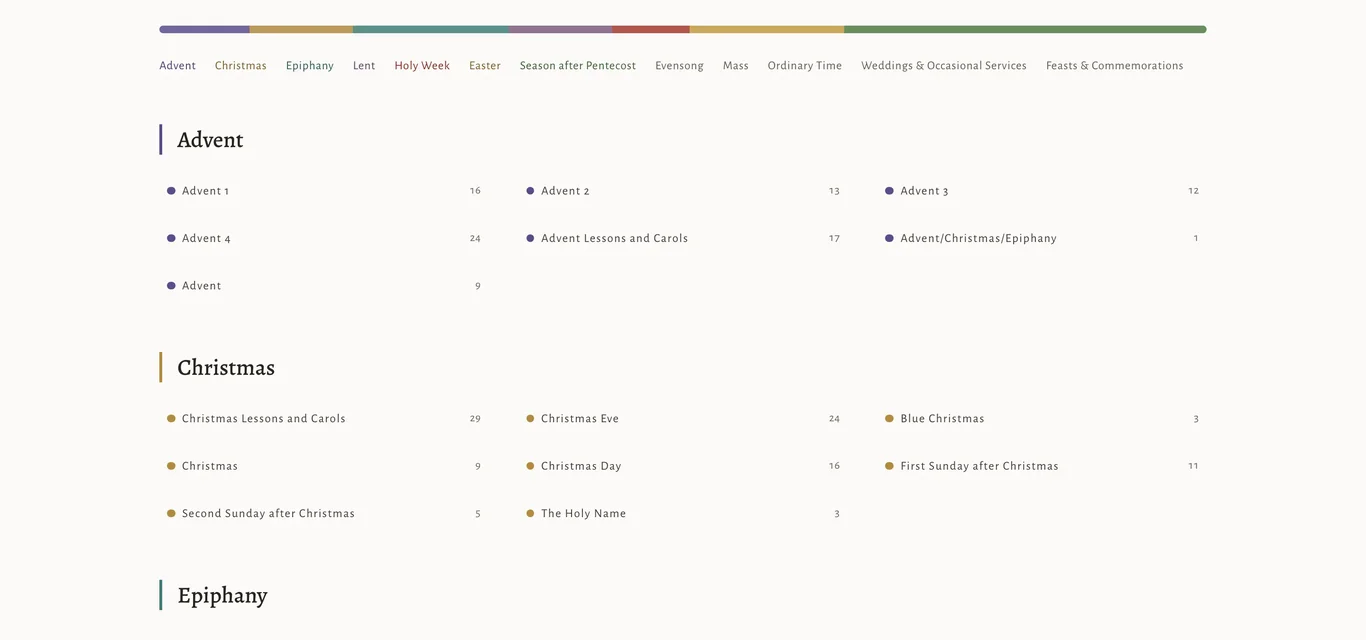
The database opens on the liturgical calendar: Advent through the Season after Pentecost, then the groups the lectionary does not reach, Evensong and Mass settings and weddings and the commemorations. Each season carries its own color and each day shows how many works are waiting on it. Everyone in the building reads those colors already, so the color carries structure instead of decoration, and it costs a visitor nothing to learn.
Above the calendar sits the filter bar the sheet could never offer: year, forces, voicing, difficulty, accompaniment, language. A director looking for something their upper-voices ensemble can sing unaccompanied in Lent gets there in two taps, and every filtered view is its own link, so they can send it to their rector or their section leaders. Each liturgical day also links out to its readings at lectionarypage.net, which is the next click anyone planning a service is going to make.
842 Works That Google Can Now Read
Every work is its own page now, and so is every composer, every poet, and every Sunday and feast of the church year. The sitemap carries 1,312 pages. The old site had six, and one of them pointed at a spreadsheet.
Which means the director in another diocese, typing “SATB Magnificat woman composer” at 9pm, now lands on the piece itself: who wrote it, whose words it sets, the voicing, the readings it was chosen for, how long it runs, who publishes it, and a recording she can play before she orders twenty copies. The publisher and the duration are the two fields she actually buys on, and they were sitting in columns of the sheet that Google never saw.
6 → 1,312
Pages a search engine can read
842 works
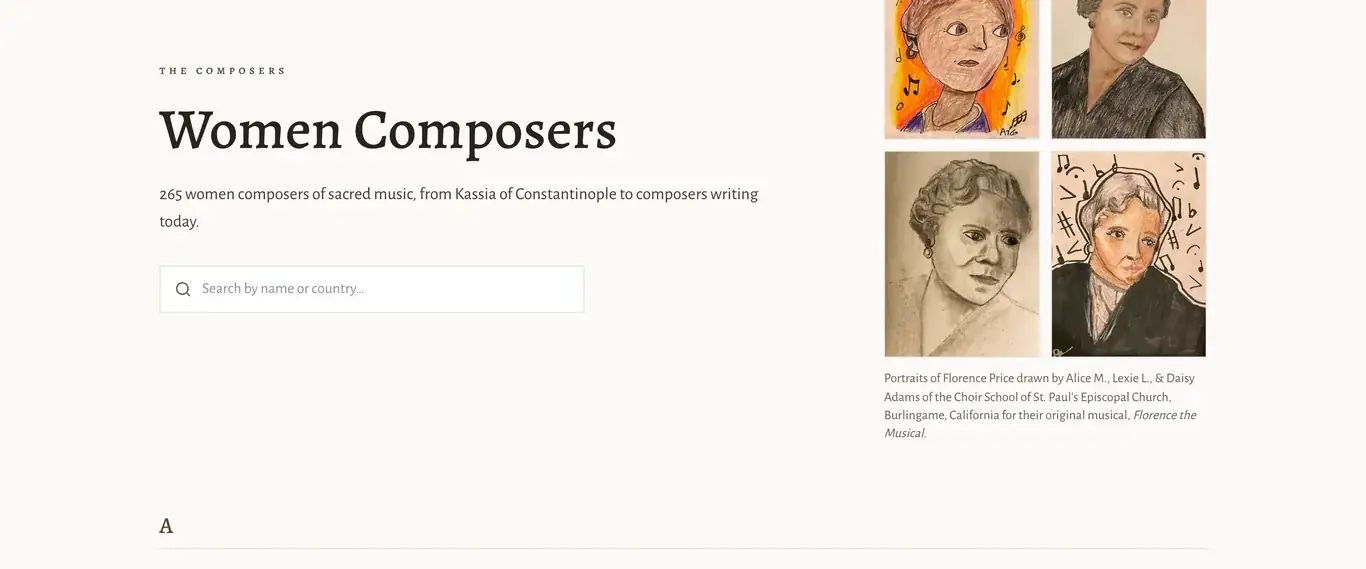
By 265 women composers, from Kassia to the living
17 tabs → 1 church year
One index instead of seventeen
Rosalie Bonighton Was a String in a Column
In a spreadsheet a composer is text that repeats down a column. Rosalie Bonighton appears eleven times and is eleven pieces of text. On the rebuilt site every name is a link to her own page: her dates, her country, her website where there is one, and her works grouped by the season they serve. The index runs from Kassia of Constantinople, writing in the ninth century, to composers who are alive and taking commissions.
Then Susan asked for something the sheet had been carrying in its formatting. She had been bolding the text sources written by women, a convention that meant something to every human who opened the file and nothing at all to any machine that read it. That bolding became the Poets section, 60 pages of women whose words are being sung, and she has since told me it is the direction she is most drawn to. It sat in the data for three years and could not be seen until the data became a website.
Most of These Decisions Were Liturgical, Not Technical
Moving 1,270 spreadsheet rows into a database is a morning’s work. Moving them correctly took knowing what the rows meant. The rows are also not 1,270 pieces: an anthem gets a row for every day it serves, which collapses to 842 distinct works across about 1,150 work-and-day pairings, with the remainder being header rows and the contributor-initial legend that each tab repeats.
A piece’s readings belong to the pairing, not to the piece
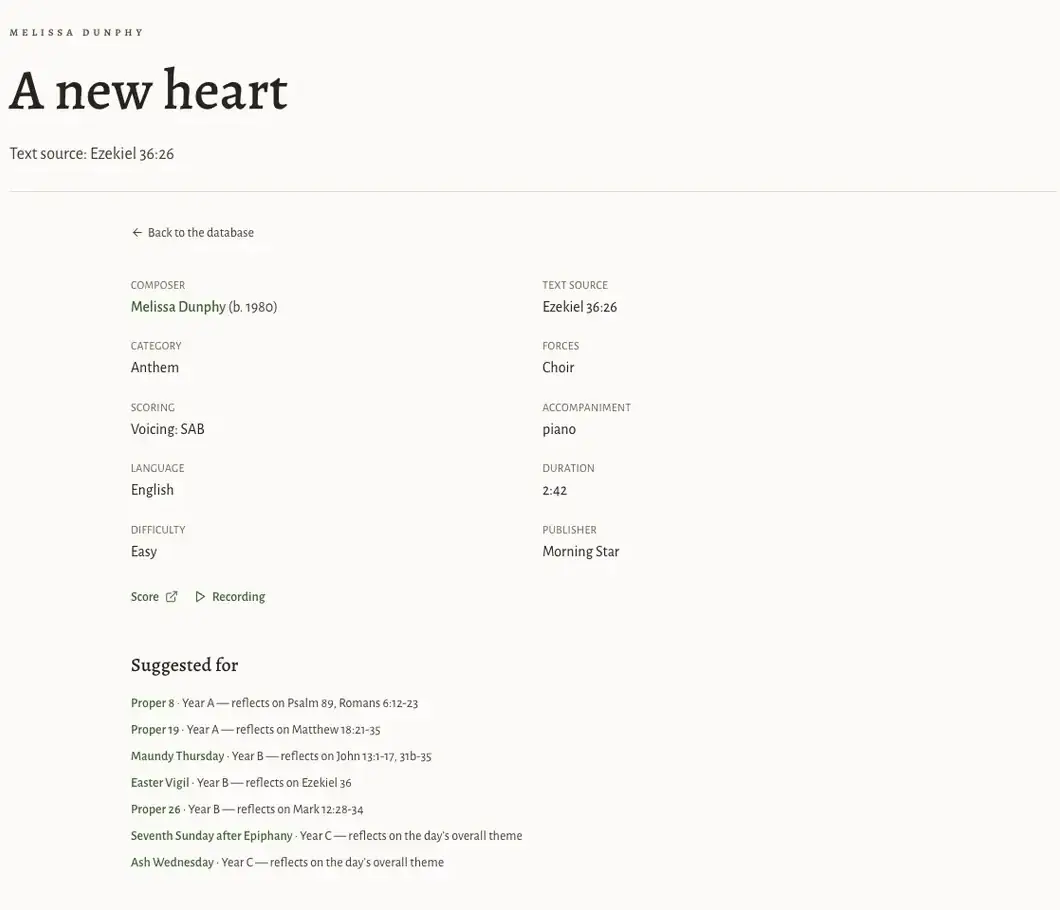
Melissa Dunphy’s A new heart sets one verse of Ezekiel and is suggested for seven days across all three lectionary years. On Proper 19 it answers Matthew’s parable of the unforgiving servant; on Maundy Thursday it answers the new commandment in John 13; at the Easter Vigil it answers Ezekiel itself. Same anthem, different reason each time. Flatten those readings onto the work and you lose the reason anybody chose it, which is the only part a director is actually reading.
Betty Jackson King files under King
Katie Burk and Katherine Burk Webb are one person. An alphabetical index that gets this wrong is worse than no index, because a director who cannot find her concludes she is not there. For a project whose whole purpose is to make these composers findable, a filing error is a mission failure wearing a typo.
Some entries have no lectionary year at all
Advent Lessons and Carols does not use the Revised Common Lectionary. It follows its own scheme of lessons, so splitting it across Years A, B and C would have made three copies of one service and hidden two of them from any given visitor. Christmas Day is sung every year too and genuinely does have three years of propers, so “we sing it annually” is not the test. The test is which lectionary the service runs on.
Organ voluntaries had inherited “a cappella”
The voluntaries were sitting inside the Sunday tabs and had picked up the accompaniment value of the choral rows around them. For an organ piece that field is not wrong, it is inapplicable, and the fix is to stop asking rather than to correct the answer. Their days needed rethinking too: this collection keys its anthems to specific Sundays and mostly treats voluntaries as seasonal.
A cell reading “SSA or SATB” has to match both voicing filters
Susan found this one. She asked me for a recommendation for a women’s choir and discovered she could not search by voicing at all, so voicing became a filter that afternoon and learned to read compound cells the same day. She found a regression in it hours later, from a link I had given her, which is how I know she uses this site for real work rather than to check on us.
None of these are website problems. They are the reason a rebuild like this usually stalls: the person who can write the code has to ask the client what a lectionary year is, and the answer arrives in a long email that gets half-implemented. It is the same shape whether the vocabulary is lectionary years, application rounds at a festival, or judging categories in a school photo competition. Somebody has to know what the words mean before the software can be right about them.
It Is Hers to Run
This is a paid engagement rather than a concept, and it is live on the client’s own domain: greathostcomposers.org, as of August 5, 2026.
The domain carried live Google Workspace mail, so the risk in that move was never the website. Moving nameservers without recreating the mail records first takes a parish’s email down, and the outage is invisible until someone mentions they never got a reply. The records were proved equivalent before the cut and the mail path was tested after it.
Susan adds and edits the works herself, in an admin built for the way church musicians describe music rather than the way a generic content system does. She corrects a composer’s name and the site republishes, with her old page address kept alive so nothing she has already emailed to her contributors breaks. She writes her own news entries. The database is a living document again, which is what it was in the spreadsheet, and the reason a spreadsheet was hard to give up.
“I’m very pleased with how this has turned out. I think once you have those additional things editable, once a month will work very well.”
The second half of that is the part I care about. She is describing a working rhythm, once a month, which only holds if she can make her own corrections. If she still has to email me to fix a typo, a retainer is just a support queue with a nicer name, and there are pages on that site I have not finished handing over yet.
The things a board asks about are all settled in her favor. She owns the domain, the registrar account, and the data. The catalogue exports. The site is static files on her own address, so it keeps serving whether or not she is still working with me, and moving it elsewhere does not require my cooperation. I would rather earn the next month than hold anyone’s website hostage to it.
One honest caveat about all those new pages: they went up yesterday. Search engines have not had time to do anything with them, and page count is an input rather than a result. I will come back and report what actually gets indexed and what people search for on the way in.
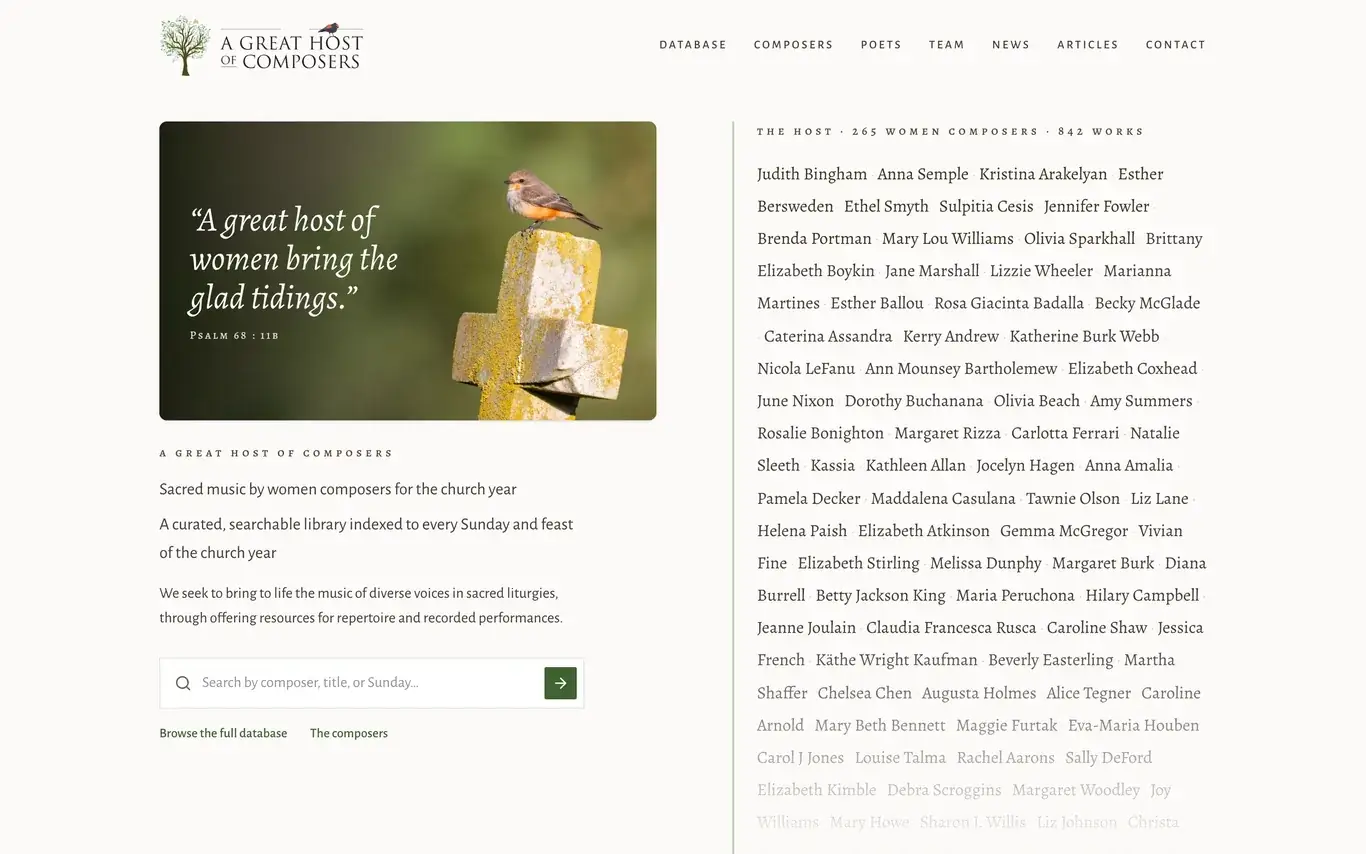 Rebuilt
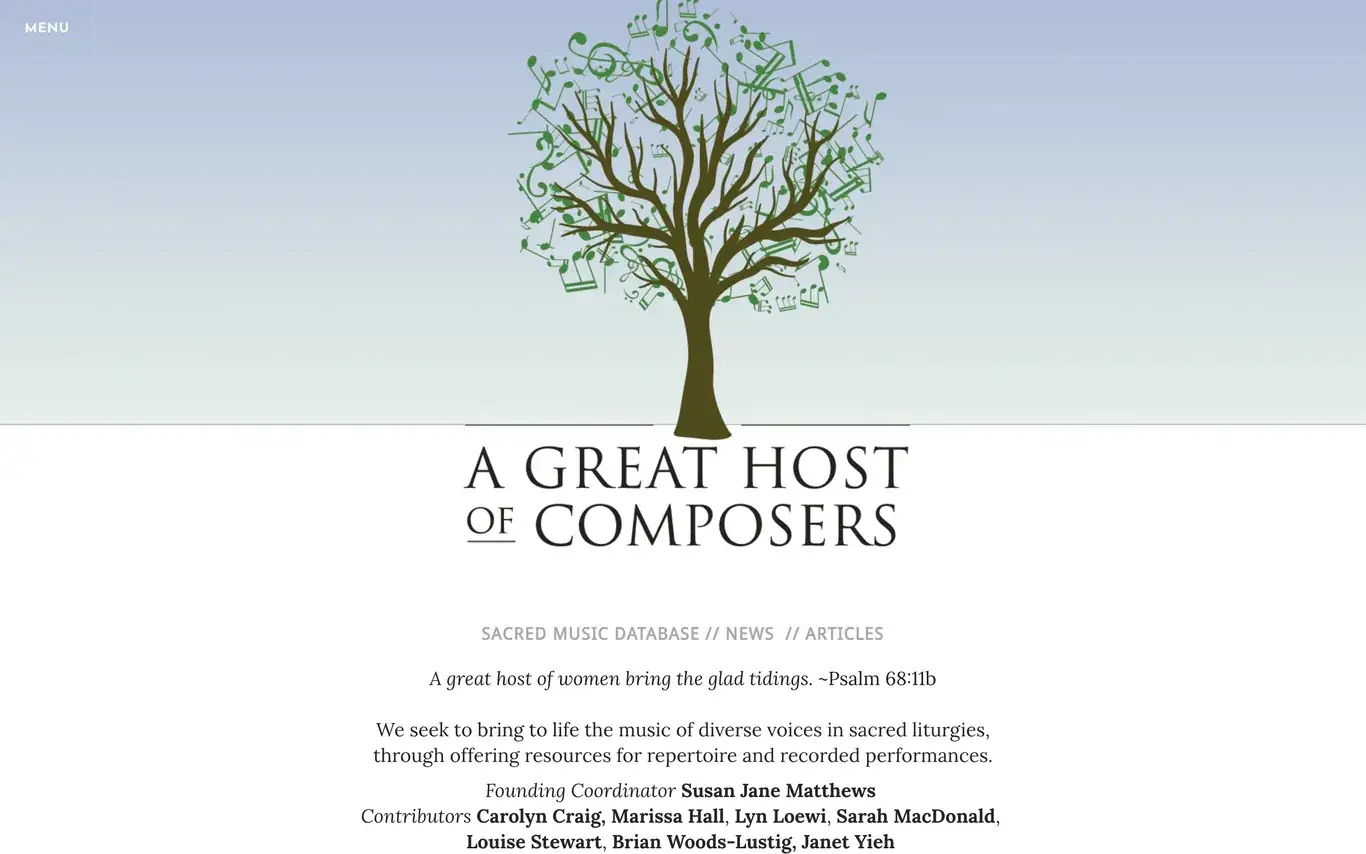 Weebly
If Your Best Work Is in a Spreadsheet
I have seen the same file at a festival, a choral society and a music school: an alumni directory, a concert archive going back forty years, a commissioning history, a repertoire list four staff members maintain in parallel. It took years, and it is parked behind a link that says “view our database.”
A spreadsheet answers questions in the order its columns happen to be arranged, and every search engine on earth treats it as one blank page. Your users arrive holding a date, a name, or a constraint, and the file makes them do the joining. It is worth turning into a website when the data is good, and it is worth doing with someone who knows what your columns mean.
Send Me the Link, Not the File
Send the URL of the page your file currently sits behind. Everything I diagnosed above, the affiliate redirect, the six pages, the fact that none of it was readable, came from the public site, so I do not need your data to tell you where you stand. Within a week you get a written read: what is invisible to search, what a rebuild would involve, and a cost range. No charge and no obligation, and I do not need the spreadsheet itself unless we both decide to go ahead.
Or write to me directly: garrett@fuguelab.com
About the Author
Garrett John Law is an organist and choir director at an Episcopal parish, and the founder of Fugue Lab, where he builds and runs the digital side for music organizations. He plans music against the same lectionary this database indexes, most weeks of the year.